 |
 |
 |
|||
 |
|||
|
|
Home > Our Clients > Case Studies > Myers Case Study MYERS CASE STUDYFrom Loss to Profitability; Our Journey to Become Lean
“There is not a single person in our organization who has not embraced with enthusiasm the Lean strategy at every location. Once introduced to the program they have thoroughly accepted its principles. Every manager, every employee in the plants is very anxious to implement Lean and once they have tasted of success there is no holding them back. Our reconditioning plants are clean and bright, as are our new drum plants. Equipment and the plants themselves are being painted and maintained. 5S has taken control of offices, plants and yards and we get better each day. But more than anything else there is a spirit of camaraderie and competition that has never existed previously. We are so proud of all of our employees. One thing I can assure you of at this stage of the game is that we'll never go back to being what we were. It has become our way of life.” Myers Container Corporation was founded in 1984 as a privately-held company. With over 250 dedicated people working at 8 U.S. locations, their goal to make Myers Container the best container company in the industry. 2004 was a dreadful year for Myers. Rising steel prices, coupled with other economic conditions, drove off any hope of profitability. Late that year, the Myers management team decided to take strong action to restore profitability. Kyle Stavig, then Vice President of Sales, learned about TCA's work with Columbia Aircraft Manufacturing of Bend, Oregon. He contacted TCA and invited us to visit their drum manufacturing plant in Portland to see if similar performance improvements could be realized. For every journey, there is also a map – or, in this case, a series of maps – directing the path to continuous improvement. Myers’ first map was a current state Value Stream Map. This map indicated the constraints to throughput and identified profit-eating cost drivers. With this map in-hand, TCA then led 24 members of the Myers management team through a series of workshops and planning sessions. Together, the team learned how to use the tools of Lean to improve throughput, collapse lead times, reduce costs, improve quality, and restore profitability. As part of those sessions, the management team created a future state Value Stream Map. Operationally, the future state showed how the company would operate with all of the constraints to flow removed and all of the operations functioning in a least waste way. In addition, Myers management went through a mini-strategic planning process to redefine the operations mission and formalize objectives. The Myers leadership team could now see how to transform the company so that they could restore profitability. Transformation Map With T-Map in hand, the management team continued their journey. Armed with a vision of the future, guided by a clear strategy, and practicing sound leadership skills learned from the TCA workshops, they set out to transform Myers Container through a series of improvement projects and kaizen events. A holisti” approach to improvement was used. Each improvement project was aimed at developing a customer-focused workforce; teaching the proper use and application of the Lean tools to improve quality, enhance throughput, increase productivity and drive off all non-value added activities to reduce cost and improve profitability. Key Lessons Learned Kyle Stavig, now President of Myers, sums up his company's Lean journey: “Preaching continuous improvement is a way of life for us now. Getting our people together, capitalizing on the collective intellectual knowledge and improvement ideas of everyone has been the key to our success.” Just 16 months into Myers Lean journey, Kyle and Jim Bise, Myers’ Lean Coordinator, shared some key lessons they learned. Their lessons are valuable for any Lean executive:
• Update the future state Value Stream Map often. • Manufacturing cells are great for manufacturing, but they work other places too. Implement cellular concepts in all areas of the business. • Keep score of key performance metrics to focus Lean improvement projects on business areas that require attention and improvement. • Maintain a Continuous Improvement List in every cell and department. • Conduct as many Kaizen Events as you can. • Use the 5S system to clean-up the facility and organize it. Summary John Cutt recently summed up the results Myers Container has achieved through Lean: “By the way, we ended up with a very good year in 2005 thanks in good measure to TCA’s guidance and direction. We achieved nearly every major goal we had established for ourselves back in the early days of 2005 including a 50% reduction in our inventories, increased revenue per employee by over 23% and, finally, reduced the number of employees by 15%, all through attrition. Now there's a success story for you.” As the Myers management team can attest, a journey of a thousand miles begins with the first step. In Myers case, the company found itself facing continued losses and unable to respond effectively to difficult economic conditions. A step in the right direction made the difference, and led to immediate and sustained profitability. Congratulations to the entire Myers team of dedicated and committed employees. Contact Us for a Free Assessment!
|
||
 Our Clients
 Overview
 Do
you ever wonder about the real benefits of Lean, about the powerful
transformation Lean can make in a company's future? Here's what
John Cutt, CEO of Myers Container Corporation, has to say:
Do
you ever wonder about the real benefits of Lean, about the powerful
transformation Lean can make in a company's future? Here's what
John Cutt, CEO of Myers Container Corporation, has to say: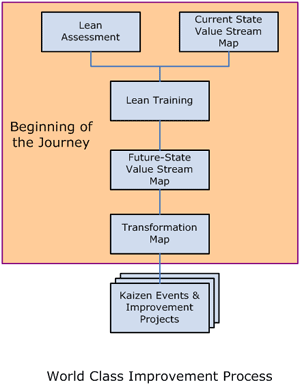 The
Journey Begins
The
Journey Begins “How
quickly can we make this happen?” was their next question.
A plan was needed to transform the business from the
current state to the desired future state. To accomplish this, TCA
introduced the Transformation Map or T-Map. It visually depicts a 3 year
process (a series of improvement projects and kaizen events) for
achieving the objectives of our operations mission over
the next 3 years.
“How
quickly can we make this happen?” was their next question.
A plan was needed to transform the business from the
current state to the desired future state. To accomplish this, TCA
introduced the Transformation Map or T-Map. It visually depicts a 3 year
process (a series of improvement projects and kaizen events) for
achieving the objectives of our operations mission over
the next 3 years.|
|